Posts

certificate in ev technology
Image
  The Electric Vehicle Development Technology Certificate prepares students for employment in product development and manufacturing occupations not only in the automotive industry, but other industries such as communications, solar, wind turbine and smart grid, including the following job categories: Development Technician Electrical Test Technician Mechanical Testing Technician Manufacturing Technician The one-year program emphasizes laboratory skills and a project-based experience. Courses include: Introduction to Electric Vehicle Propulsion Systems Electronic Technology  Motors and Controls for Electric Vehicles and Industrial Applications Electric Vehicle Data Acquisition, Sensors and Control Systems Advanced Energy Storage To learn more about visit: http://aevt.org/courses/electric-vehicle-technology-business-management.php https://aproskill.com/home/course/electric-vehicle-evse-business-course/1 https://istskill.in/course/electric-vehicle-charging-infrastructure https://...

number of EV charging stations and lack of standardization

Image
  EV Charger Market 2020-2027  The global electric vehicle charger market was valued at $3.8 billion in 2019, and is projected to reach $25.5 billion by 2027, registering a CAGR of 26.8% from 2020 to 2027. Factors such as government regulations to limit environment pollution, increase in market penetration of electric vehicles, and surge in government initiatives for development of electric vehicle charging infrastructure drive the growth of the electric vehicle charger market. However, limited number of EV charging stations and lack of standardization of EV charging are anticipated to hamper the market growth. Further, surge in demand for luxury and feature enabled vehicles and wireless charging for electric vehicles are expected to create numerous opportunities for EV chargers market expansion. Electric vehicle charging infrastructure is vital for the mass adoption of electric vehicles. Several government initiatives have been undertaken to provide EV charging stations acros...

f selection and optimization close to perfection

Image
  Next generation battery technology   WHAT IS IT? In lithium-ion (Li-ion) batteries, energy storage and release is provided by the movement of lithium ions from the positive to the negative electrode back and forth via the electrolyte. In this technology, the positive electrode acts as the initial lithium source and the negative electrode as the host for lithium. Several chemistries are gathered under the name of Li-ion batteries, as the result of decades of selection and optimization close to perfection of positive and negative active materials. Lithiated metal oxides or phosphates are the most common material used as present positive materials. Graphite, but also graphite/silicon or lithiated titanium oxides are used as negative materials. WHAT ARE ITS ADVANTAGES? Today, among all the state-of-the-art storage technologies, Li-ion battery technology allows the highest level of energy density. Performances such as fast charge or temperature operating window (-50°C up to 125°C...

charges the car completely in just 60 minutes

Image
  How electric cars are charged WHAT ARE THE DIFFERENT WAYS TO CHARGE EVS? There are 2 primary ways to charge Mahindra EVs: Normal Charge: Comes with a port installed at home/work place or from a charging station. Time taken for a complete charge depends on the drive train capacity. Quick Charge: Innovative charging technology with the Quick Charge charges the car completely in just 60 minutes. But the time taken to charge each car varies according to the model. HOW DO I CHARGE THE CAR? It is as easy as charging any of your other technology devices. All you have to do is plug the vehicle into any of the charge points available to you. To know the voltage and ampere requirements for each product, click on the images below: The time it takes to charge an electric car can be as little as 30 minutes or more than 12 hours. This depends on the size of the battery and the speed of the charging point. A typical electric car (60kWh battery) takes just under 8 hours to charge from empty-...

decarbonise the whole transport sector

Image
  EV Chargers in India   India has embarked on an ambitious program to introduce  EV  (Electric Vehicle) in a big way to transform the entire transport sector. Given this stated objective to decarbonise the whole transport sector, VerdeMobility, a unit of System level Solutions, has joined hands with one of the largest operators of Sigfox, iWire Technologies, to develop the world’s first Sigfox enabled, Electric Vehicle Charging Stations. It is the first of its kind low-cost EV charging solutions manufactured in India. The different product variants can be used for personal or commercial purposes, drawing power from the grid or solar systems. With a mobile app that allows the vehicle owner to find the nearest available charging station, make payments based on charge and online, this unique machine is the ‘thing’ every Government, Company with fleets, Mall owners, petrol pumps, need to implement. Both companies aim to manufacture chargers in India and supply...

EV chargers that will be mandatory

Image
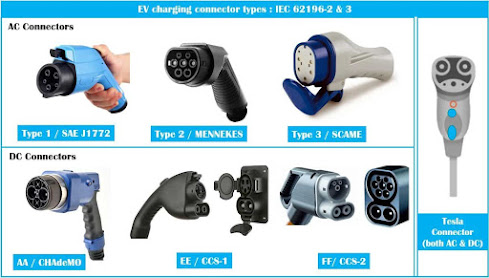
  EV charging station every 25 km   The types of EV chargers that will be mandatory at each charging station make the latest EoI distinct from the earlier one. Successful bidders will have to install CCS 2 and CHAdeMO chargers in addition to Bharat Chargers. A CCS 2 fast charger earmarked for the programme (minimum 50 kW) can fully charge the Tata Nexon EV or a Hyundai Kona EV, for instance, in about 60 mins. CCS 2 is the most favoured charger in India with every electric car being compatible with it. The EOI also gives interested parties the option to set up a CHAdeMO (minimum 50 kW) charger. CHAdeMO chargers are favoured by Japanese car manufacturers and powers models such as the Nissan Leaf and Honda Fit. No electric car in India is compatible with CHAdeMO. One Bharat Charger DC-001 (15kW) is also to be installed with either CCS 2 or a CHAdeMO charger. Bharat AC-001 (10kW) and Type 2 AC (22kW) have been kept as optional chargers for the bidders. “The proposed charging stati...

A novel technology

Image
  quantum dot solar cell   A novel technology that can improve the efficiency of quantum dot solar cells to 11.53% has been unveiled. Published in the February 2020 issue of  Advanced Energy Materials , it has been evaluated as a study that solved the challenges posed by the generation of electric currents from sunlight by solar cells by enhancing the hole extraction. A research team, led by Professor Sung-Yeon Jang in the School of Energy and Chemical Engineering at UNIST has developed a photovoltaic device that maximizes the performance of quantum dot solar cells by using organic polymers. Solar cells use a characteristic of which electrons and holes are generated in the absorber layer. The free free electrons and hole then move through the cell, creating and filling in holes. It is this movement of electrons and holes that generate electricity. Therefore, creating multiple electron-hole pairs and transporting them are an important con...